I teach classes on the history of political philosophy, feminism, and critiques of capitalism.
Feminist Critique and Politics
Eugene Lang College of Liberal Arts at the New School, Undergraduate.
Feminist protests against gender inequality and injustice are on the rise around the world. The gendered issues of domestic violence, reproductive rights, care, underpaid female work, sexuality, and sexual harassment continue to be at the center of today’s popular mobilizations. What changes do feminist movements demand? What commonalities and differences do their participants have with each other? What conflicting utopian visions of equal, free worlds coexist within feminist political struggles? The course provides a survey of key feminist theoretical debates, both historical and contemporary, about power, equality, and freedom. By discussing the works of revolutionary suffragettes, liberal, socialist feminists, as well as radical, decolonial, environmental, intersectional, queer, and anti-racist feminist thinkers, we will reconstruct core agreements and disagreements in feminist critique of the current political and economic system. Readings include Olympe de Gouges, Alexandra Kollontai, Simone de Beauvoir, Maria Mies, Martha Nussbaum, Nancy Fraser, Angela Davis, Patricia Hill Collins, María Lugones, Judith Butler, and Shireen Hassim, among others.
Politics and Emotions
Eugene Lang College of Liberal Arts at the New School, Undergraduate.
Emotions are often viewed as a private and personal part of human life. Against this view, critical theorists argue that our emotions are, in fact, constructed by political and social systems. This course explores the ways in which politics and society shape human emotional experience. It is divided into two parts. The first part provides an overview of the key emotional categories used in public and political life. Here we will examine the emotions of love, friendship, fear, compassion, loneliness, and anger, and their historical relations to political regimes and ideologies. The second part asks what emotions people experience in modern capitalist society, and why. It explores Marxist, feminist, queer, anti-racist, and decolonial critical theories of emotions. Readings will include Aristotle, Thomas Hobbes, Jean-Jacques Rousseau, Charles Fourier, Alexandra Kollontai, Sigmund Freud, Herbert Marcuse, Frantz Fanon, Myisha Cherry, Eva Illouz, Deborah Gould, and Achille Mbembe, among others.
Western Political Thought I: Ancient and Medieval
Saint John’s University, Undergraduate.
The course introduces foundational texts of Western political theory from the ancient and medieval periods. In this class, we will explore classical conceptions of politics, democracy, oligarchy, tyranny, equality, justice, law, and utopian order that have shaped modern political thinking. By reading the works of Plato, Aristotle, Cicero, Augustine, Aquinas, Christine de Pizan, and Thomas More we will examine key ideas of Ancient political philosophy and discuss their relevance to modern politics. Special attention will be given to the study of text analysis, comparison, and interpretation.
Roots of Modern Ideologies
Saint John’s University, Undergraduate.
Politics begins with political ideologies. As coherent systems of ideals and demands, political ideologies guide the struggles of politicians, parties, social movements, social and cultural institutions, as much as those of individuals. What kinds of ideological systems influence political life? How to distinguish between them and identify a variety of political forces? The course provides a survey of key modern political standpoints. In this class, we will explore historical and theoretical roots of the major political worldviews. We will define and compare political ideals of liberalism, democracy, conservatism, nationalism, socialism, feminism, and communism among others. By reading their key thinkers and reconstructing their central demands, we will examine commonalities and differences existing between these conflicting political projects.
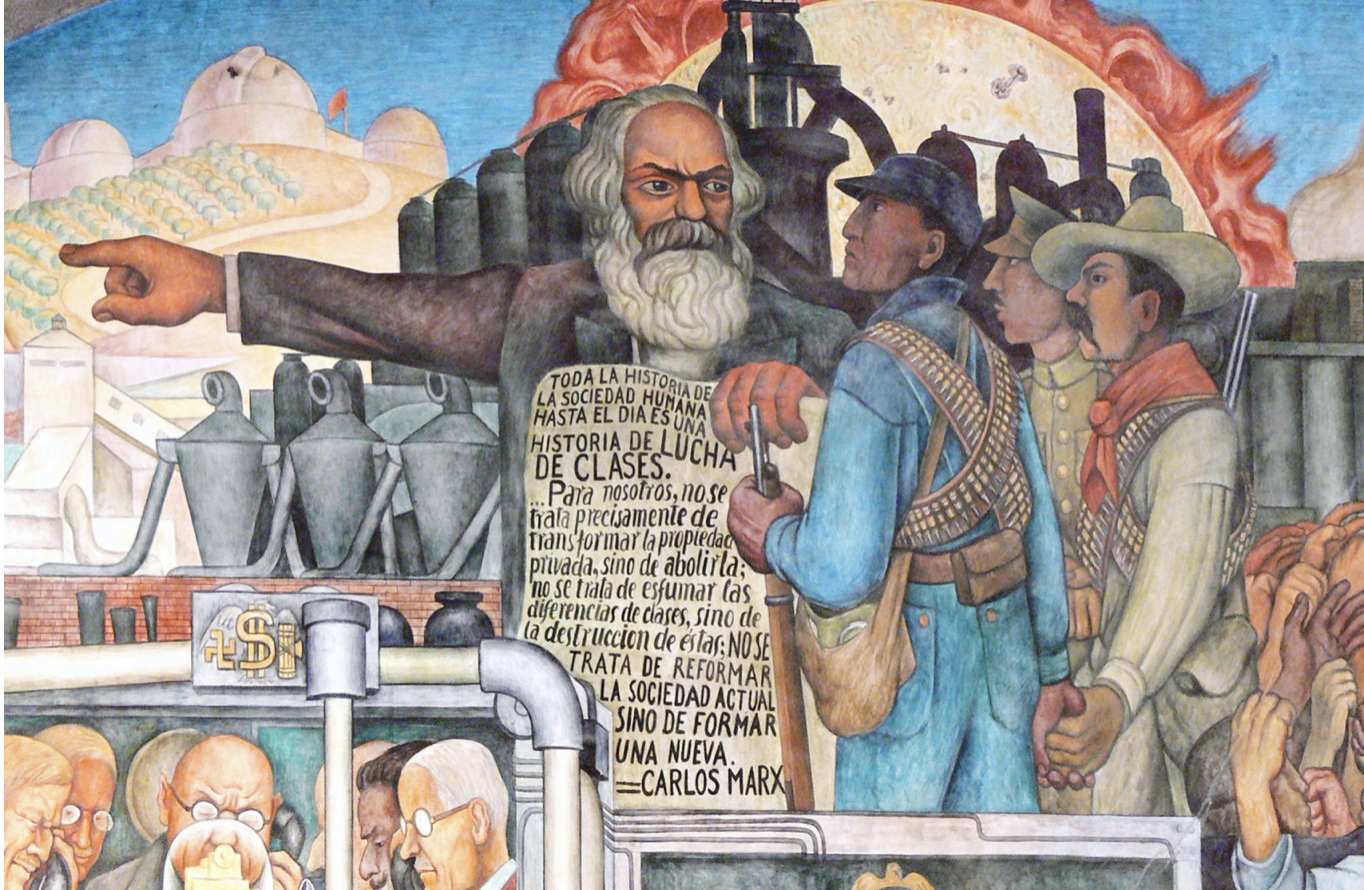
Diego Rivera, Mexico Today and Tomorrow, 1935